
Thermtec
ThermTec makes more than handheld spotters. This category includes thermal monoculars such as the Wild and Cyclone models, thermal riflescopes including the ARES 2.0 and VIDAR 2.0, HUNT Pro thermal add-ons and Ventus multi-spectrum binoculars. To narrow the choice quickly, decide which of three things you mainly need: a device to scan and observe, a dedicated sight, or thermal imaging added to an optic you already own. The guide below the products explains the trade-offs that matter for each.


ThermTec Cyclone 315 Thermal Monocular
Original price was: £849.00.£599.00Current price is: £599.00.
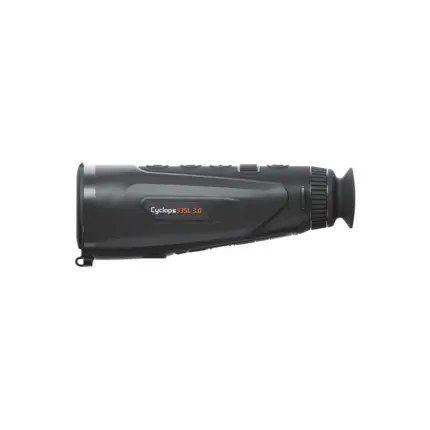
ThermTec Cyclops 335L 3.0 Thermal Monocular
Original price was: £1,199.00.£1,119.00Current price is: £1,119.00.


Thermtec Wild 635L Thermal Monocular
Original price was: £1,899.00.£1,749.00Current price is: £1,749.00.
Thermtec Wild 650 Thermal Monocular
Original price was: £1,949.00.£1,799.00Current price is: £1,799.00.
Thermtec Wild 650L Thermal Monocular
Original price was: £2,199.00.£1,949.00Current price is: £1,949.00.Buyer guide
Start with the job the device will do most
Decide how you will mainly use the device before you choose a format. The ThermTec range here falls into four broad roles.
- Searching and observing in your hand. A handheld thermal monocular such as a Wild, Cyclone or Cyclops model is built for sweeping fields and hedgerows and watching what you find.
- A dedicated sight. The ARES 2.0, VIDAR 2.0, Oryx-L and iBEX families are thermal riflescopes. A riflescope is designed primarily as a sight. A handheld is more convenient for sweeping ground and observing.
- Adding thermal to an existing day optic. ThermTec designs the HUNT Pro units as thermal clip-on add-ons that sit in front of a day optic. ThermTec's user manual also describes a monocular mode for the HUNT 335 Pro, 635 Pro and 650 Pro, so these units are not limited to one role.
- Two-eyed observation. The Ventus 635L and 650L are multi-spectrum binoculars. They let you observe with both eyes rather than holding a monocular to one eye.
If most of your time is spent finding and watching animals, start with an observation device. If you already have a good day optic and want thermal in front of it, an add-on may be the better fit.
Choosing a handheld for woodland or open ground
Field of view and lens focal length are the main trade-off. The right balance depends on where you look.
Close cover, woodland edges and hedgerows
A wider field of view takes in more of the scene at once. This makes it easier to sweep cover and keep a moving subject in frame.
Open fields and longer distances
Where the sensor and optical design are otherwise comparable, a longer focal length gives a narrower field of view. On that same comparable basis, it also spreads a distant subject across more pixels. This can help when you are watching something far off. When comparing models with different sensors, compare the stated field of view directly.
Two cautions apply to a longer lens:
- The narrower view shows less of the scene at once, so scanning is slower.
- It does not guarantee a better image on its own. Usable detail also depends on sensor resolution, focus, image processing and the conditions on the night.
Handling and power
These matter more than many first-time buyers expect. If you will carry a monocular through long sessions, compare size, weight and the battery arrangement as well as the image specifications.
Models in the same family do not necessarily share a specification. Two Wild models, for example, can differ in sensor, lens and power, so compare the exact models you are considering.
What a thermal image actually shows
A thermal imager responds to infrared radiation from the scene. It does not need visible light.
Two important contributors to the signal are:
- radiation emitted by a surface, which depends on the surface's temperature and material
- radiation reflected from the surroundings
The atmosphere between the imager and the subject can also affect the signal and add to it.
There is no fixed balance between these contributions. It changes with the material, the viewing angle and the conditions. An observation image shows differences in this signal across the scene, and it does not necessarily give calibrated surface temperatures. Temperature measurement needs a calibrated radiometric device, and capabilities differ between devices and models.
In suitable conditions, this is why a warm animal can stand out clearly against cooler cover. Contrast is not constant, though. Rain, fog and high humidity can reduce it. So can periods when a subject and its background give off similar signals.
Digital night vision works differently. It forms an image from available visible or near-infrared light, often with help from an infrared illuminator. It therefore depends on light in a way that thermal imaging does not.
Reading detection ranges sensibly
A published detection range is the distance at which a heat source might register as something, under the manufacturer's own test assumptions. It is not the distance at which you will know what that something is. Recognising the type of animal usually needs a much shorter distance, and confidently identifying it needs a shorter distance still. Weather and background can shorten all three distances.
Brands may use different target sizes, definitions and test conditions. A bigger detection figure on one spec sheet therefore does not automatically mean a better device than a smaller figure on another. Use detection figures to compare models measured on the same basis. Use other specifications, such as sensor resolution, focal length and field of view, to judge how the device will suit your ground.
Power and features worth comparing
Battery type, battery arrangement and runtime can vary between ThermTec models. Real-world runtime can also depend on settings and temperature.
Features can vary too. Some product names include "LRF", which indicates a laser rangefinder. Examples are the ARES 660L LRF 2.0 and the HUNT Pro 650L LRF. A similar letter in another model name, or membership of the same series, is not proof that a model has one.
Compare thermal sensitivity (NETD) model by model, because series-level marketing figures do not always match individual model specifications. Check the listing for the exact model you are considering to confirm its power, features and what is included.
Frequently asked questions
Should I buy a thermal monocular, a thermal scope or a clip-on first?
It depends on what you will do most often.
- Mostly searching and observing: a handheld monocular or a Ventus binocular is the natural starting point, because that is the job it is designed for.
- Mainly a dedicated sight: a thermal riflescope is designed primarily as a sight. If you will also do a lot of scanning, a handheld is convenient for that.
- You already own a day optic you are happy with: a HUNT Pro add-on is designed to bring thermal imaging to that optic rather than replace it.
If you expect to need more than one format eventually, choose the one that solves your most frequent task first.
Is a wide field of view or a longer lens better for my ground?
For woodland, hedgerows and closer cover, a wider field of view usually makes scanning easier. For open fields, a longer focal length can put more pixels on a distant subject, but only where the sensor and optics are otherwise comparable. The cost is a narrower view.
If your ground is mixed, choose for the conditions you face most often rather than for the occasional long look. No lens choice on its own guarantees more usable detail.
Can a HUNT Pro be used as a handheld monocular as well as a clip-on?
ThermTec's HUNT Pro user manual describes both clip-on and monocular modes for the HUNT 335 Pro, 635 Pro and 650 Pro. Using a second mode can depend on particular parts, such as an eyepiece or adapter. The manual does not say which parts come with a particular listing.
The manual's description covers only those three models, so do not assume it applies to the HUNT Pro 650L LRF. If you plan to use both modes, confirm the supported modes and supplied parts for the exact model before buying.
If a device lists a long detection range, will I be able to identify an animal at that distance?
No. Detection means a heat source may be noticed under the manufacturer's test assumptions. Identifying what it is usually needs a much shorter distance. Weather, background and the subject's size all affect what you will actually see.
Treat a detection figure as a guide for comparing like-for-like specifications, not as a promise of field performance.
Does a thermal image show the real temperature of what I am looking at?
Not necessarily. The imager responds to infrared radiation from several sources:
- radiation emitted by a surface
- radiation reflected from the surface's surroundings
- radiation affected or added by the atmosphere in between
There is no fixed balance between these contributions. Two objects at the same temperature can look different, and a reflective surface can look warmer or cooler than it really is.
An observation image does not necessarily give calibrated surface temperatures. Calibrated radiometric devices can estimate temperatures, but capabilities differ between devices and models. Do not assume a device measures temperature unless the exact model's specification says so. For observation, read the image mainly as a picture of contrast.
Do all ThermTec devices have the same battery, runtime and features?
Not necessarily. Battery arrangement, runtime, controls and features such as laser rangefinding can differ between models, including within the same family. Runtime in use can also vary with settings and cold weather.
Compare the exact model's specification rather than assuming anything from the series name.