Pixfra
Pixfra’s range covers handheld thermal viewers, thermal and digital day/night sights, and Draco binoculars that combine thermal and visible-light viewing. Start by choosing the format and imaging type that suit your task. Then use the guide below the products to compare field of view, sensor and handling. If you mainly want to watch wildlife, the related ranges below include our Pixfra Wildlife collection.


Pixfra Arc A425 Pro LRF Thermal Monocular
Original price was: £1,149.95.£1,099.00Current price is: £1,099.00.
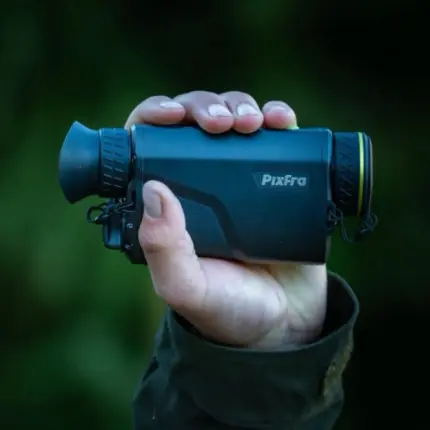


Pixfra Arc A625 Pro LRF Thermal Monocular
Original price was: £1,449.95.£1,399.99Current price is: £1,399.99.


Buying guide
Choose the format by how you'll look
How you'll hold the device and how long you'll look through it usually narrow the choice faster than any specification.
- Handheld monoculars (currently Arc and Mile 2) are designed mainly as dedicated handheld viewers for scanning and observation. Consider one if you want a viewer you can carry and use on its own.
- Binoculars (Draco) give you two-eyed viewing. Draco also gives you more than one image type in one device. Consider them for observation where you want to switch between a thermal view and a visible-light view without changing devices.
- Sights (Cetus and Pegasus thermal, Volans digital day/night) are sold mainly as sighting devices. If you need both scanning and sighting, decide which role matters most. Then compare how each model's documented features support each role, rather than assuming what a format can or can't do.
Thermal, digital night vision or both
Thermal imaging forms its picture from differences in infrared radiation. The signal reaching the sensor is a mix of:
- radiation emitted by an object
- thermal radiation reflected from the object's surroundings
- the effect of the air in between
That mix has no fixed proportion. It varies with the surface, the surroundings and the atmosphere. An ordinary observation image therefore doesn't necessarily give you a measured surface temperature, and measurement capabilities differ between devices. The same scene can look crisp one evening and flatter the next as surroundings warm or cool. Thermal imaging doesn't need visible light. It can help you find warm subjects where they contrast clearly with a cooler background.
Digital night vision uses a digital sensor to capture available visible or near-infrared light. Depending on the model, light levels and image mode, its picture can look closer to an ordinary image than a thermal view, which helps when appearance matters as well as presence. In very dark conditions, it often relies on infrared illumination. How much detail you see depends on the device, the illumination and the scene.
Multispectral devices such as Draco combine both approaches in one unit. You can use the thermal view to find something, then switch to the visible-light view to see more of its appearance when the available light and conditions allow.
Compare the specifications that shape the view
- Field of view is the most direct guide to how much of the scene you see at once. Where models state it, compare it directly. A wider field makes it easier to scan and follow movement. A narrower field shows a smaller part of the scene. When sensor resolution and other design factors are comparable, a narrower field places more pixels on a distant subject.
- Lens focal length works together with the sensor. A longer lens narrows the field and raises base magnification only when sensor size and optical design are comparable. If those differ, rely on the stated field of view rather than the lens figure.
- Sensor resolution is the number of pixels the sensor records. At a comparable field of view, higher resolution can put more pixels on the subject. The optics, focus, image processing and conditions also affect how much detail you actually see. Pixel pitch is the spacing between pixels. Together with resolution, it determines the active imaging area, which is why lens figures alone can mislead.
- Base magnification tells you how large the scene appears before any zoom is applied. It gives you a consistent starting point when comparing models.
Consider handling and everyday use
Compare the documented dimensions, weight and power source of the models on your shortlist rather than judging by format alone. These details matter more the longer you carry or hold a device. Think about how often you'll pick the device up and how long each session lasts. Then check which models suit that pattern. For sights, assess handling against the sighting role rather than general observation.
Related ranges
- Thermal monoculars: handheld thermal viewers from several brands, if you want to compare beyond Pixfra.
- Thermal rifle scopes: thermal sights from several brands.
- Multispectral binoculars: binoculars that combine more than one imaging type.
- Pixfra Wildlife: Pixfra devices selected for observation. Some products appear in both Pixfra collections.
Frequently asked questions
What's the difference between a thermal monocular and a thermal sight?
Their main purposes differ. A thermal monocular is designed mainly as a handheld viewer for scanning and observing. A thermal sight is sold mainly as a sighting device. If you need both roles, start with the one that matters most to you. Then compare each model's documented features against both needs, rather than assuming one format will or won't cover them.
What do the multispectral views on Draco binoculars mean?
Pixfra's UK distributor describes Draco binoculars as offering thermal, daytime and digital night vision views. The manufacturer's manual describes a thermal image alongside day, twilight and night modes for the visible image. In practice, the thermal view can help you spot something by its infrared signal. The visible views can then show more of its appearance, depending on the available light and conditions. Mode options and accessories can vary between Draco versions.
Should I choose a wide field of view or more reach?
It depends on whether you're mainly searching or mainly studying. A wider stated field of view keeps more of the scene in frame. That helps when you're checking fields, hedgerows or woodland edges, or following moving subjects. If you usually study subjects you've already spotted further away, a narrower field can help. When sensor resolution and design are comparable, it places more pixels on the subject. Compare stated fields of view rather than lens sizes alone, because lens figures can mislead when sensors differ.
What's the difference between detection and identification?
Detection means noticing that something is there, such as a heat signature standing out from its background. Identification means making out what it is. Identification needs much more image detail on the subject, so you'll usually detect a subject well before you can identify it. A detection distance doesn't tell you how far away you'll be able to identify something. Both depend on the subject's size and contrast, the sensor and lens combination, image processing and the conditions.
Which Pixfra models have a laser rangefinder?
It depends on the model and version. Several listings in this range carry "LRF" in their names, including Pegasus 2 P335 LRF, Volans V850 LRF and Draco D635-4K LRF. Being part of a family doesn't mean every version has a rangefinder. A name without "LRF" doesn't prove that a version lacks one, either. If ranging matters to you, treat it as a deciding specification and confirm it for the exact version.
Should I choose thermal or digital night vision?
They're different ways of observing, so choose by what you most need to see. Thermal forms its image from infrared radiation and needs no visible light. It can help you pick out subjects that contrast with their surroundings. Depending on the model, lighting and image mode, digital night vision can give a picture closer to an ordinary image, which helps when appearance matters. In very dark conditions, it often depends on infrared illumination. If you want both approaches in one observation device, look at multispectral binoculars.