
InfiRay
Browse InfiRay thermal imaging devices, including handheld monoculars such as the Iris IL19 and Iris IL35 and thermal riflescopes such as the Tube TP25SE. If you’re unsure which type suits you, our buying guide below the products can help.

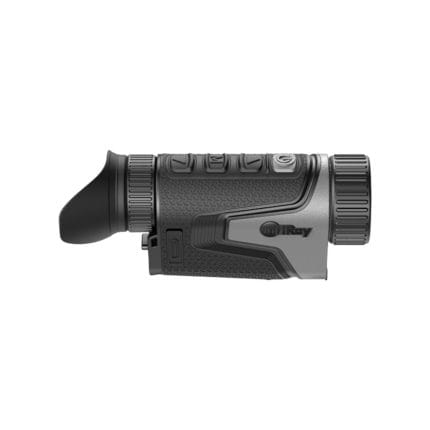
Infiray Iris IL35 Thermal Monocular
Original price was: £1,499.95.£949.95Current price is: £949.95.Choosing an InfiRay thermal device
Handheld monocular or thermal riflescope
Handheld monoculars and dedicated thermal riflescopes are generally built for different jobs.
The Iris monoculars are handheld observation devices. You carry one, raise it to your eye to scan an area, and lower it again. It works on its own, without being fixed to other equipment.
The Tube TP25SE is a thermal riflescope, which is designed to serve as a sight.
Consider handling as well as the image. Think about how you will carry the device, how quickly you need to bring it into use, and whether it needs to work independently.
Field of view and magnification
Field of view is how much of the scene the device shows at once.
- A wider view takes in more of the landscape. You can sweep an area with fewer movements and follow a subject that moves across it.
- A narrower view gives the screen to a smaller part of the scene. It can help when you are watching a subject you have already found, depending on the model, the level of detail you need and the task.
Magnification makes the image appear larger on the screen. Enlarging the picture does not add detail that the sensor and lens did not capture. A bigger image can be easier to look at, but it is not necessarily clearer.
Each model's field of view and magnification depend on its own sensor, lens and display. Read both figures from that model's specification table rather than working one out from the other.
What a thermal image shows
A thermal imager builds its picture from infrared energy. Some of that energy is emitted by surfaces and some is reflected from them. The balance changes with the surface and its surroundings. Humidity, rain and fog also affect what reaches the sensor.
On an observation device, the image generally shows contrast in infrared signal. It does not necessarily measure or display temperature, although some radiometric devices do. A subject stands out because its signal differs from the background. In some conditions, a subject cooler than its surroundings can stand out too.
Frequently asked questions
How should I compare InfiRay devices with other brands?
Compare like with like. Set a handheld monocular against other monoculars, and a thermal riflescope against other thermal sights. Within a format, read field of view and magnification from each model's specification table. Compare detection figures only where the definitions match.
To see other brands in each format, browse our thermal monoculars and thermal rifle scopes categories.
How do I choose between the Iris IL19 and IL35?
Start with how you will use the device. InfiRay's Iris user manual (English, PDF) covers the series and lists different lens and field-of-view configurations. The choice therefore comes down largely to how much of the scene you want to see at once.
- If you mostly scan open ground for movement, give more weight to a wider field of view.
- If you mostly watch distant subjects you have already found, a narrower view may suit you better, depending on the detail you need.
Then compare the two models' figures side by side in the manual's table, and check the product listing for the exact version.
Do I need a handheld monocular, a thermal riflescope or both?
Choose by the main job:
- For observing and scanning, look at handheld monoculars such as the Iris models.
- For a dedicated thermal sight, look at riflescopes such as the Tube TP25SE.
Some thermal devices are designed for more than one role. Check each model's documentation for its intended uses rather than assuming one format can replace the other.
Is a detection range the same as the distance at which I can identify an animal?
No. Detection means the device shows that something is there. Identifying it as a particular animal needs more detail. You cannot assume identification at the advertised detection distance.
Advertised detection ranges are manufacturer ratings based on a specified test target and test conditions. Manufacturers do not all use the same assumptions, and they do not always publish them in full.
In the field, results depend on:
- the subject's size;
- how strongly it contrasts with its background;
- the atmospheric conditions.
When comparing models, compare detection figures only where the targets and definitions match.
What should I check about power and accessories?
Read the manual for your exact model alongside its product listing.
Published figures can change between documents. For example, Iris manuals published at different times quote different battery runtimes. Make sure the manual you use matches the model and version you are buying.
Check:
- the power source;
- what comes in the box;
- any accessories the device needs.
Manufacturer documents describe the device, not necessarily the package sold. Confirm what is supplied on the product listing before you order.
Manufacturer documents: Iris user manual (English, PDF) and Tube SE quick-start guide, version 2.0 (PDF, about 1 MB).