
SpyPoint Trail Cameras

SpyPoint’s FLEX and FORCE trail cameras give you two ways of getting your images back. The FLEX-M is a cellular camera, made to send images from the site to your SpyPoint account. The FORCE-PRO records locally, so you collect the images from the camera itself. The range also includes the FORCE-PRO-S 2.0, FLEX E-36, FLEX-S and FLEX-PLUS.
Decide first how you want to receive what the camera captures. The guide below the cameras then explains storage, capture modes and what a cellular camera needs to keep delivering.
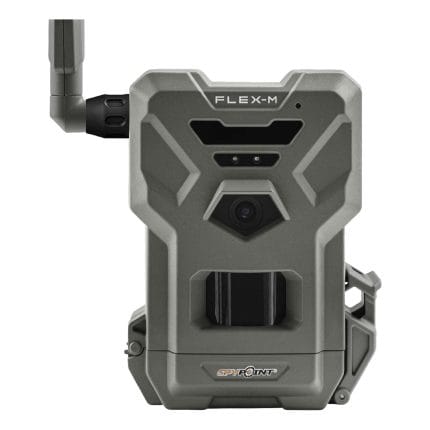
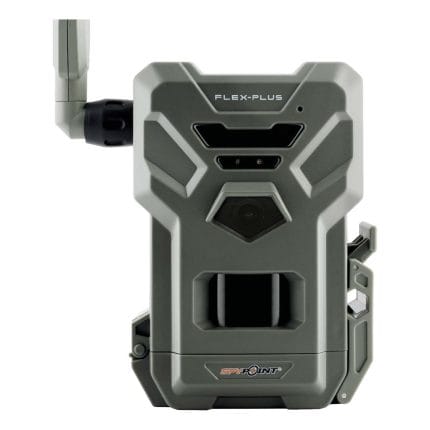
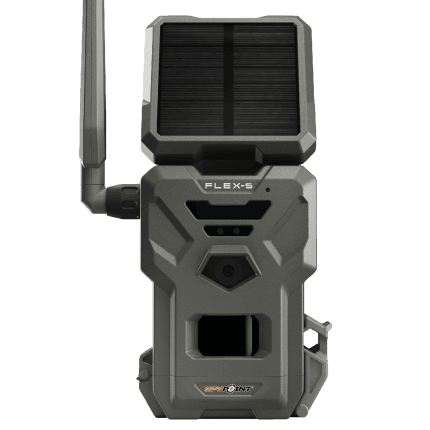
How do you want to get your images back?
Remote delivery. A cellular camera such as the FLEX-M sends images over a mobile network to an account you view through the SpyPoint app. You can follow activity at a feeding station, a field gateway or a remote corner of woodland between visits. That suits sites that are awkward to reach or that you would rather disturb as little as possible.
Local recording. A non-cellular camera such as the FORCE-PRO saves everything to its memory card, and you review the images when you visit the camera. This keeps the arrangement to the camera, its card and its power, which suits places you pass regularly or where you are happy to collect results in batches.
When you compare the FORCE-PRO-S 2.0, FLEX E-36, FLEX-S and FLEX-PLUS, make cellular or local recording the first point you confirm for each camera. The family name alone is not the guide.
Capture, storage and delivery: three separate steps
Every image goes through up to three stages, and each relies on something different. Capture is the camera taking a photo when its settings and power allow. Storage is that file being saved to the memory card, which needs free space. Delivery applies only to cellular cameras: it is the camera sending the image on to your account, which needs network reception, an active transmission plan and power.
Seen this way, ‘sends to a phone’ and ‘uses a card’ are not alternatives. A cellular camera still records locally, and a picture can be captured and saved before, or without, reaching your account. The essential condition for remote delivery is reception: it depends on a usable mobile connection at the spot where the camera is placed.
Deployment choices that shape your pick
- Capture pattern. Motion-triggered capture takes pictures when the camera detects movement, while a scheduled pattern photographs a scene at set intervals whether or not anything moves. Decide which record you want before comparing models.
- Site activity. A busy trail or bird table produces far more captures than a quiet hedge line. Expect card space and, on a cellular camera, your delivery allowance to be used faster.
- Power arrangement. Capture frequency and transmission both draw power. Match the camera's supported power arrangement to how long you intend to leave it and how often you can return.
- Visits. If you will be at the site every few days anyway, local recording may be all you need. If visits are rare, remote delivery tells you what is happening in between.
If you want to weigh SpyPoint against other makes with the same cellular-or-local question in mind, our wider trail camera range brings them together.
Frequently asked questions
Which SpyPoint cameras can send images remotely?
The FLEX-M is a cellular example: SpyPoint classes it as a cellular trail camera for sending images to your account. The FORCE-PRO is SpyPoint's non-cellular example, recording to its card for you to collect. For the other models, confirm the connectivity type for each camera rather than going by whether its name begins with FLEX or FORCE.
Does cellular delivery depend on reception where the camera is placed?
Yes. The camera needs its own working connection to a supported mobile network at the exact position where it is fixed, not just somewhere nearby. Capture and upload are separate events. A camera in a weak spot can still take and save pictures that it cannot send at that moment. Choosing a position with dependable coverage is part of choosing the site.
Does a cellular camera still use a memory card?
Yes. SpyPoint's FLEX activation guidance treats the memory card as one of the camera's requirements, alongside its power source, the account and the app. Images are stored on the card as well as being sent, so card choice and free space matter on a cellular camera just as they do on a local-recording one.
What is the transmission plan for?
The plan is the service that covers remote image delivery to your account and sets how much can be sent. It sits apart from buying the camera. You choose the hardware, the camera records to its card, and the plan governs what is transmitted from it. SpyPoint organises its plans by region, so treat the plan as its own decision when budgeting for a cellular camera.
How is time lapse different from motion-triggered capture?
Motion-triggered capture responds when the camera detects movement, giving you a record of the activity it picks up. Time lapse follows a schedule, taking images at set intervals to show gradual change such as feeding patterns across a field or water levels at a pond. SpyPoint's FLEX-series manual, which includes the FLEX-M, documents both modes and settings that combine them.
Is photo resolution the same as trigger speed or night illumination?
No. These are three different parts of how a camera works. Resolution describes the pixel dimensions of the image, and so how much detail it can hold. Trigger performance describes how the camera responds when something moves into view. Illumination describes how the scene is lit for pictures after dark. A high figure in one says nothing about the others, so compare each on its own when choosing between models.
Why do capture settings matter for a longer deployment?
Every capture creates a file and uses power, and on a cellular camera each transmission adds to that. A short time-lapse interval or a busy motion-triggered site produces many more files and draws more power than a sparse schedule at a quiet spot. For a camera you plan to leave for a while, decide capture frequency, card space and the power arrangement together, and weigh them against how long it will be until your next visit.