Pard
Our PARD range includes handheld thermal monoculars, thermal and digital night vision riflescopes, night vision add-ons for day scopes, and multispectral scopes and binoculars. Infrared illuminators, modules and a camera complete the range. Start with the job you need done: scanning and observing, sighting, or adding night vision to a scope you already use. Then compare the models of that type.


Pard Landsat 256 Mini LRF Multi-Spectral Scope
Original price was: £1,130.00.£569.95Current price is: £569.95.
Pard Landsat 640 C LRF Multispectral Scope
Original price was: £2,999.00.£2,459.00Current price is: £2,459.00.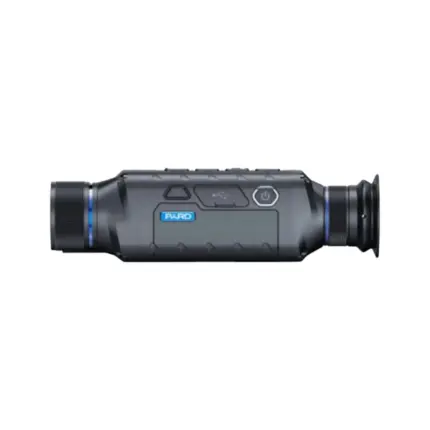
Pard Leopard 256 (16mm) Thermal Monocular
Original price was: £639.99.£599.00Current price is: £599.00.
Pard Leopard 640 eX LRF (35mm) Thermal Monocular
Original price was: £1,660.00.£1,614.00Current price is: £1,614.00.Pard Leopard 640 eX LRF (50mm) Thermal Monocular
Original price was: £1,850.00.£1,804.00Current price is: £1,804.00.
Pard Leopard 640 LRF (35mm) Thermal Monocular
Original price was: £1,589.95.£1,499.00Current price is: £1,499.00.
PARD Night Stalker 4K 2.0 LRF 50mm Night Vision Scope
Original price was: £699.00.£649.95Current price is: £649.95.Choosing Within the PARD Range
PARD makes several kinds of device, so choose the job first and the model second. The current range divides like this:
- Scanning and observing: Leopard thermal monoculars are handheld units for spotting and scanning. The Osprey multispectral binoculars offer another observation format. Browse all thermal monoculars.
- Thermal sighting: The Pantera series are dedicated thermal riflescopes. Compare them with other thermal rifle scopes.
- Digital night vision sighting: The Night Stalker and NV008 families are standalone digital night vision scopes. Browse more night vision rifle scopes.
- Adding night vision to a day scope: NV007 models are add-ons used together with a separate optic. See the full range of night vision add-ons.
- Multispectral scopes: The Landsat models and the TD32-70 combine more than one imaging channel in a single scope.
- Illumination and recording: TL3 infrared illuminators and IL1 and IR1 modules add infrared light. The Action 4K is a separate camera.
Thermal, Digital Night Vision or Multispectral
Thermal imaging builds its picture from differences in the infrared signal that reaches the sensor. That signal can include:
- infrared emitted by objects
- infrared from the surroundings reflected off their surfaces
The proportions vary, and the air between you and the scene also affects the signal. As a result, contrast changes with weather, humidity, time of day and the surfaces in view. An observation image shows relative differences in signal. It does not necessarily display actual temperatures.
Digital night vision works with available visible and near-infrared light. The way illumination is handled differs from one PARD model to another.
Multispectral devices combine more than one imaging channel in one unit. You can use a single device rather than switching between two.
Frequently Asked Questions
Should my first PARD device be a handheld thermal or a scope?
Decide which job matters most to you. A handheld monocular such as a Leopard is built for scanning and observing, and you don't need a rifle to use it. A riflescope such as a Pantera or Night Stalker is a dedicated sight. If observation is your main need, a handheld device is the relevant type. If sighting is the priority, start with scopes. You can treat observation and sighting as separate jobs, so one device doesn't have to do both.
How do I choose between versions of the same PARD model?
Several PARD families come in more than one version. For example, the category lists the Leopard 640 LRF in 35mm and 50mm lens versions, and the Night Stalker 4K 2.0 LRF in 50mm and 70mm lens versions. Suffixes such as eX and LRF also mark different versions within a family.
Put the versions side by side and compare:
- stated field of view
- size and weight
- power arrangements
- image characteristics
Will a PARD night vision add-on fit my day scope?
Fit depends on three things working together: the add-on version, your optic and the adapter that joins them. PARD's manual for the NV007SP LRF shows that eyepiece add-on fitted with a size-specific adapter. That manual covers that one model only. It does not cover the NV007SP2 or NV007V2.
Before ordering, have your optic's make and model to hand. Confirm:
- the exact add-on variant
- the adapter it needs
- what the listing includes
It's also worth asking how the combination will affect focus, field of view and reticle visibility on your setup.
Do I need a separate infrared illuminator for PARD digital night vision?
Not necessarily. Illumination differs across PARD's digital night vision models. Whether extra infrared light helps depends on the device, the available light and how far you want to see. If you want to add infrared light, the range includes TL3 illuminators in N850 and N940 versions, plus IL1 and IR1 modules. Each module is named for particular PARD devices.
Is an advertised detection range the same as how far I can identify something?
No. Detection means noticing that something is there. Recognition and identification mean telling what it is, and they need more image detail. A detection figure doesn't tell you the distance at which you'll recognise or identify a target. Real results depend on the target, the device and the conditions.
What does a multispectral PARD device offer?
It brings more than one imaging channel into a single unit. For example, the TD32-70 is listed as a multispectral thermal night vision riflescope. The Landsat models are multispectral scopes, and the Osprey is a multispectral binocular for observation. If you would otherwise carry or swap between separate thermal and night vision devices, a multispectral unit is the type to compare. Look at which channels each model combines, as well as its field of view, size and power.